Drain Cleaning Florida — The Deep Guide
How Does Florida Weather Stress Drain Lines?
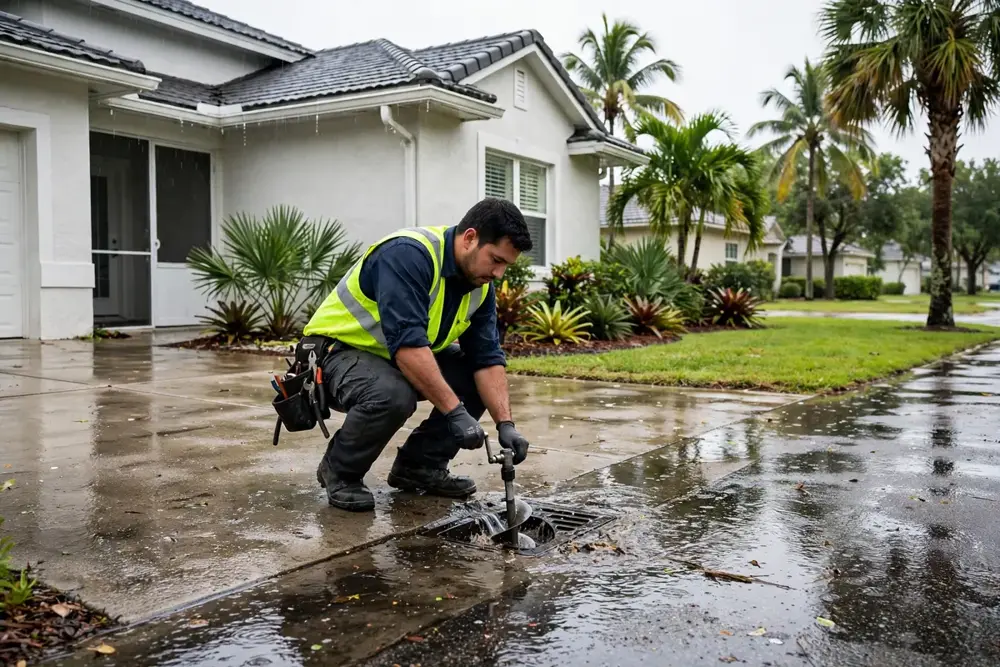
Florida weather stresses drains because the state gets its rain in bursts. NOAA's 1991–2020 Climate Normals put statewide average annual precipitation around 50–55 inches, and tropical systems can drop a season's worth of water in days.
A healthy line shrugs that off. A line narrowed by roots, grease or sand does not — it reaches capacity, and the water chooses the lowest opening in the house. That is the whole mechanics of the classic Florida backup: not a broken pipe, but a full one, at the worst possible moment.
How Old Are Florida's Sewer Laterals?
One in three Florida homes — 34.0%. Pre-1980 laterals are typically cast iron pipe inside the house and clay pipe outside it. Homes outside the city systems sit on a septic tank instead — a different failure pattern the camera sorts out quickly. Tree root intrusion at the clay joints or cast iron outside it: materials that corrode, scale and open at the joints as decades pass.
Newer Florida construction mostly uses PVC, which resists roots and corrosion far better. The state's drain map is therefore two maps at once — older coastal and inland towns fighting pipe age, newer suburbs fighting grease, wipes and storm load. Your city page on this site shows your city's own median build year and pre-1980 share, so you can see which map you live on.
Who Regulates Plumbers And Drain Work In Florida?
Florida plumbing contractors answer to the Department of Business and Professional Regulation and its Construction Industry Licensing Board, and the department's site (myfloridalicense.com) offers a public license check. The Florida Division of Emergency Management (floridadisaster.org) is the state's hub after storms and floods, and the Office of Insurance Regulation (floir.com) oversees the insurers homeowners argue with after water damage.
None of that replaces common sense on the day: ask the visiting pro who they are, what they found, and what they recommend — and use the state's own sites, linked in this page's sources, to verify anything you want in writing.
Does Homeowners Insurance Cover A Florida Sewer Backup?
Sometimes, and the detail matters. Clearing the blockage itself is usually a maintenance cost. The damage the backup causes — floors, drywall, belongings — is where policies differ: many Florida policies require a specific water-backup endorsement, and flood water from outside the home is handled under separate flood coverage, a live issue in a state with Florida's water table.
Photograph the damage before cleanup, keep the pro's invoice and findings, and call your insurer early. The Office of Insurance Regulation's consumer guides explain Florida claim timelines in plain language. After declared storms, FEMA flood maps and claims guidance shape what documentation insurers ask for, which is one more reason the camera record matters.
What Moves The Cost Of Drain Cleaning In Florida?
Access first: a blockage reached through an outside cleanout is simpler work than one behind a pulled toilet or under a slab. Method second: snaking a soft clog is quicker than jetting a grease-and-sand line or cutting a root mass, and a camera inspection adds certainty that can prevent paying twice. Line condition third: a repair discovered on camera is a different job from a cleaning.
This site publishes no prices because nobody can price a line they have not seen. What you can hold any pro to is an explanation of these factors for your line before work begins.
Why Inspect Before Jetting Older Florida Pipes?
Hydro jetting is powerful enough to strip a pipe wall clean — and powerful enough to open up a cast-iron section that corrosion has already thinned to foil. In Florida's older neighbourhoods the careful sequence is CCTV sewer camera first, jet second: look at the pipe, learn its material and condition, then choose the pressure and tool it can take.
The same logic protects clay laterals with root-split joints. A camera turns the method choice from habit into judgment, which is why diagnosis sits at the centre of how local pros here work.
When Should Florida Lines Be Cleaned?
The state's calendar gives the answer its shape. Lines with a history of storm backups are cleaned most effectively in late spring, before the wettest months arrive. Lines shaded by big oaks benefit from a root check before the summer growth peak. And any line that has backed up twice in a year has stopped being a cleaning question and become an inspection question.
A simple rule: clean on a schedule only if your pipe's history says so — roots, grease or storm patterns — and let a camera, not a calendar, make the final call. Kitchen lines deserve their own rhythm: grease buildup (FOG) narrows them month by month, and a line cleaned before the holidays survives the cooking season that clogs the rest.
One Drain Slow, Or The Whole Main Line?
A single slow fixture is a branch problem: that sink's trap, that shower's hair mat, that kitchen line's grease. Several fixtures slowing together, gurgling when other water runs, or water appearing in the lowest drain is the main line asking for attention — the pattern Florida pros are called about most.
Start with the pattern, because the pattern picks the fix. Branch problems are small and local. Main-line problems are the ones that become emergencies in a storm, and the ones worth a camera look even after they clear.