
Signs Of A Clogged Main Sewer Line
Signs Of A Clogged Main Sewer Line — a homeowner guide.
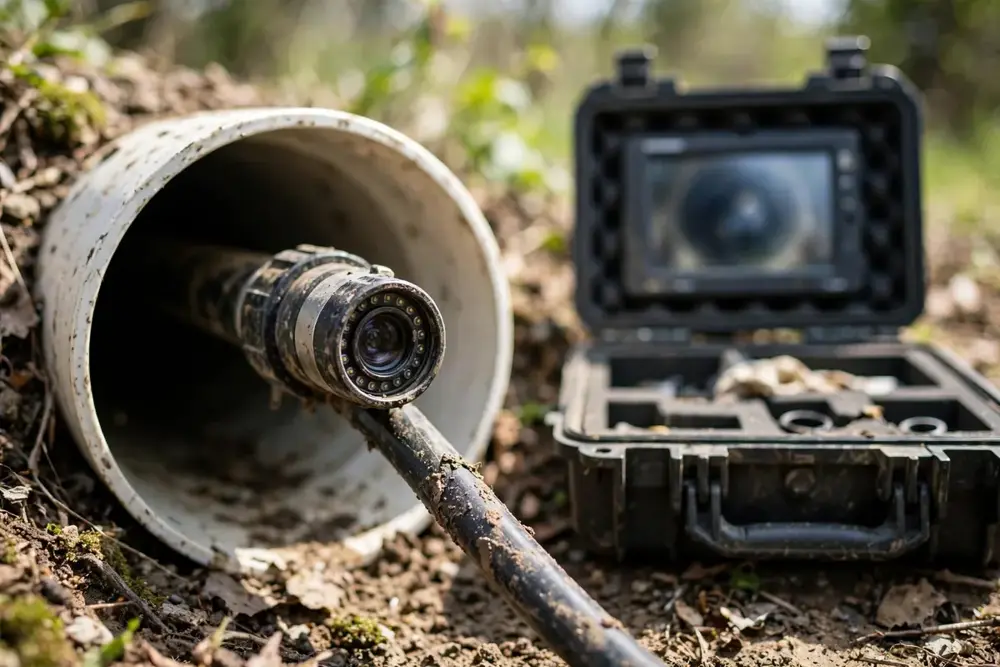
A sewer camera inspection sends a waterproof CCTV sewer camera on a flexible cable through your drain line and shows the inside of the pipe on a monitor, live. It finds the things no amount of guessing can: roots at the joints, cracks, scale, grease shelves and sagging sections that hold water. For a first whole-house backup — or a clog that keeps returning — it is usually the single most useful step, because it turns the repair decision into a picture you can see yourself.
The camera sees the inside of your pipe, lit by its own LEDs, as a colour picture on the pro's monitor — and it is more revealing than most homeowners expect. Tree roots appear as pale, hair-like masses pushing through joints. Grease shows as yellow-white shelves narrowing the pipe. Cast iron reveals its rust crust in orange and black, and clay pipe shows every joint it was laid with, each one a small step the water has to climb.
Just as usefully, the camera sees what is not there. A line that looks clean on camera but still drains slowly points the investigation at the vent stack or a single branch instead of the main line. And standing water that never drains from one stretch marks a belly — a sagging, bellied pipe — as clearly as a footprint in mud. Diagnosis stops being an opinion at that point; it is a recording, usually with a distance counter showing exactly how far down the line each finding sits.
A camera inspection is worth it whenever the answer changes what you would do next. The clearest cases: a whole-house backup (several drains at once), a clog that returns to the same line within months, an older home whose pipe material nobody knows, and any moment a pro starts using the word 'repair' — because repair money should never move on a guess.
It is also worth it before hydro jetting an old line. Jetting strips a sound pipe beautifully and can open a corroded one like a zip. Knowing whether the pipe under your yard is sturdy PVC or 1960s cast iron is the difference between a cleaning and an accident, and the camera is how you know.
When is it not the priority? A single slow sink with every other fixture draining freely is a branch problem, and a simple clearing is a reasonable first step. If that branch clogs again quickly, the calculation changes — recurring is the camera's keyword wherever it appears.
The pro starts at an access point — normally the yard cleanout, the capped pipe near your foundation. If no cleanout can be found, a toilet may be pulled to reach the main line, which is slower and one reason knowing your cleanout's location matters. The camera head, a small waterproof unit on a stiff push-cable, goes in and travels the line toward the street while the pro watches the monitor.
Findings are called out by distance: roots at 38 feet, a crack at 52, standing water from 60 to 71. Many systems record the run, and the pro can drop a marker above ground with a sonde line locating receiver that reads the camera head's signal through the soil — so '52 feet from the cleanout' becomes an X on your lawn, not a mystery. A typical inspection of a residential line takes well under an hour once access is open.
The camera travels through the whole family of residential pipe: cast iron pipe in pre-1980 homes, vitrified clay pipe in older laterals, PVC pipe in modern builds, and occasionally Orangeburg pipe — the fibre pipe that deforms with age. Along the way it passes the parts homeowners know by their failures: the P-trap under a sink, the floor drain in a basement, the grease trap on a commercial kitchen line, and the junction where a home on a septic tank or a municipal sewer sends everything onward. A storm drain is a different system entirely, and the camera is often what proves a backup is not coming from it.
The diagnosis it produces names the trade's standard problems in plain terms: tree root intrusion at the joints, grease buildup (FOG) on kitchen lines, mineral scale and pipe corrosion inside cast iron, a bellied pipe holding water, a frozen drain line in winter states, and sewer surcharge after storms — in Texas, expansive clay soil shifting the lateral itself. And it guides the tools that follow: a motorized drain snake (auger) to restore flow, a root cutter head for the root mass, chain descaling for cast-iron crust — each chosen because the picture showed it would work.
If water is rising in your home right now, flow first, picture second: the pro clears the line to stop the emergency, then cameras the open line to learn why it closed. That sequence — restore, then diagnose — is the standard for emergencies, and the guides on this site describe the same order on every emergency page.
If nothing is actively backing up, camera first is often the smarter spend. It can save you paying for a jetting the pipe cannot take, or for a repair aimed at the wrong stretch. The honest framing: the snake answers 'can it drain?', the camera answers 'why wouldn't it?' — and the second answer is the one that stops the problem coming back.
Roots at a joint mean the joint leaks vapour into the soil and roots followed it in; cutting them restores flow, and the joint's condition decides whether they will simply return. A belly — standing water in the picture — means the pipe sags and drops its load there; cleaning helps temporarily, and only re-grading or replacing that section fixes it. Scale means cast iron is narrowing from inside; descaling can restore much of its width if the wall beneath is sound.
A clean, sound line with a soft clog is the happiest finding of all: clear it, note it, and go back to normal life. The camera's real gift is that each of these futures is visible before you pay for any of them. One more finding matters after Florida storms: evidence of sewer surcharge, when the street main pushed back into the line — the kind of detail FEMA flood documentation and insurers both ask about.
Access is the big factor: an open yard cleanout keeps things simple, while a pulled toilet or a buried cleanout that must be found first adds time. Line length matters too — a long lateral out to the street takes more cable and more care. Whether the line must be cleared before the camera can travel it is the third factor; a camera cannot see through a root ball.
This site publishes no prices, for the same reason it publishes no arrival promises: nobody can quote your line honestly without seeing it. What you can expect is the factors explained for your property, and a recording that makes the findings checkable rather than a matter of trust.
Ask what material your line is and how old it appears. Ask where each problem sits, by distance, and whether it is active or historical. Ask what they would do if it were their house — and what they would watch instead of fixing today. And ask for the recording. A pro who cameras lines all day will answer all of it without blinking; the answers are the inspection's real product, even more than the pictures.
One free call connects you with a local pro who can check it in person.
Call (800) 555-0100Free Call · Answered 24/7 · Local Pros Near You
Guides are a start — a pro on site is the finish. These city pages are where a camera inspection becomes a visit: each one carries its city's data, ZIP list and nearest neighbours.
A real person answers 24/7 and can connect you with a local pro.
(800) 555-0100Once the pro has access — usually through the yard cleanout — most residential lines are inspected in well under an hour. Finding a buried cleanout or pulling a toilet to reach the line adds time before the camera ever goes in. The inspection itself is unhurried by design: the pro is reading the pipe, and the distance counter makes every finding a location, not a guess.
No — the camera needs a path. In a total blockage the pro clears the line first, at least enough to restore flow, and then runs the camera through the opened pipe. That order is normal in emergencies: flow first, picture second. Trying to push a camera head through a root mass or a collapsed section risks the equipment and learns nothing.
Yes — the monitor is the point. Most pros are happy to have you watch over their shoulder and will slow down at the important stretches: the root mass, the crack, the belly holding water. Ask questions while it runs; it is much easier to understand your line with the picture moving than from a description afterwards. Many systems also record the run for you.
No. The camera head is smooth, smaller than the pipe, and travels on a flexible push-cable designed for exactly this. It is one of the gentlest things that will ever go through your sewer line — far gentler than the cables and water pressure used to clear it, and the entire reason it is used to judge whether those stronger methods are safe.
Then the conversation changes from cleaning to repair, and you will be glad the camera found it before money went into clearing a line that cannot stay open. The pro can show you the collapse, locate it above ground with the camera's signal, and explain the repair options. Nothing about that is good news, but it is exactly the news an inspection exists to deliver.
It is one of the highest-value checks a buyer can order, especially on homes built before 1980, when laterals are clay or cast iron and may never have been looked at. A standard home inspection does not camera the sewer line. Sellers rarely know its condition; the camera settles it in an hour, and a root-choked lateral is a negotiating fact, not a surprise for your first month.
Snaking treats; the camera diagnoses. A snake restores flow by cutting or pushing through the blockage, but it tells you nothing about the rest of the line — the crack ten feet past the clog is invisible to it. The camera shows the whole run and its condition. In practice they work as a pair: clear the line, then look at it, then decide what it actually needs.
Yes, if the joint they entered through is still open — cutting removes the mass, not the doorway. The camera record shows which joint the roots use, and that decides the follow-up: monitoring on a schedule, or a repair that closes the entry. This is why 'we cut roots last year' is useful history to give the pro; it usually means the doorway is still there.
It measures how far the camera head has travelled from the access point, so every finding has an address: roots at 38 feet, a belly from 60 to 71. Combined with a surface locator that reads the camera head's signal through the ground, it turns findings into exact spots in your yard — which is what makes any later repair a targeted dig instead of an excavation.
One free call on this site connects you with an independent local pro who does this work in your city — the same call that handles drain emergencies around the clock. Say you want an inspection, mention any backup history and your home's age if you know it, and ask for the recording of the run before the visit even starts.
Reviewed By Hamza
Master Plumber & Emergency Drain Clearing Specialist
Hamza is a certified master plumber and emergency drainage specialist with more than 15 years of hands-on experience clearing main lines, sewer laterals and storm-drain systems. He has handled midnight sewage backups, root-choked clay laterals and grease-dam emergencies across hundreds of callouts, and he reviews every guide on this site for technical accuracy before it is published.
Updated October 31, 2026
One free call connects you with an independent local pro for a camera inspection — answered 24/7.
Call (800) 555-0100Free Call · Answered 24/7 · Local Pros Near You