Quick Answer
A sewer smell in the house is a message with a short list of senders: a dry trap, a blocked vent, a cracked line, or waste sitting where it should be flowing. The full walk-through follows below.
House Sewer Smell Causes, From Trap To Vent
A sewer smell in the house is a message with a short list of senders: a dry trap, a blocked vent, a cracked line, or waste sitting where it should be flowing. Each has a signature — where the smell lives, when it strengthens, what accompanies it — and the signature names the fix.
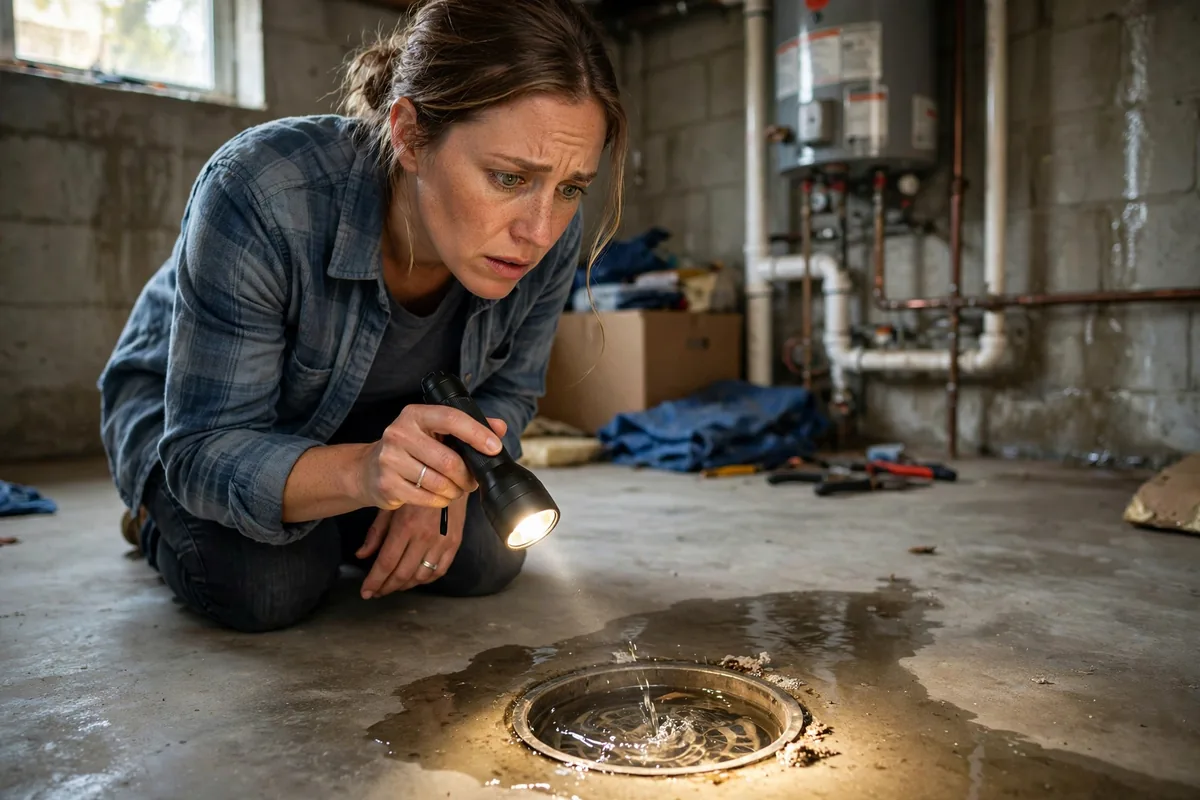
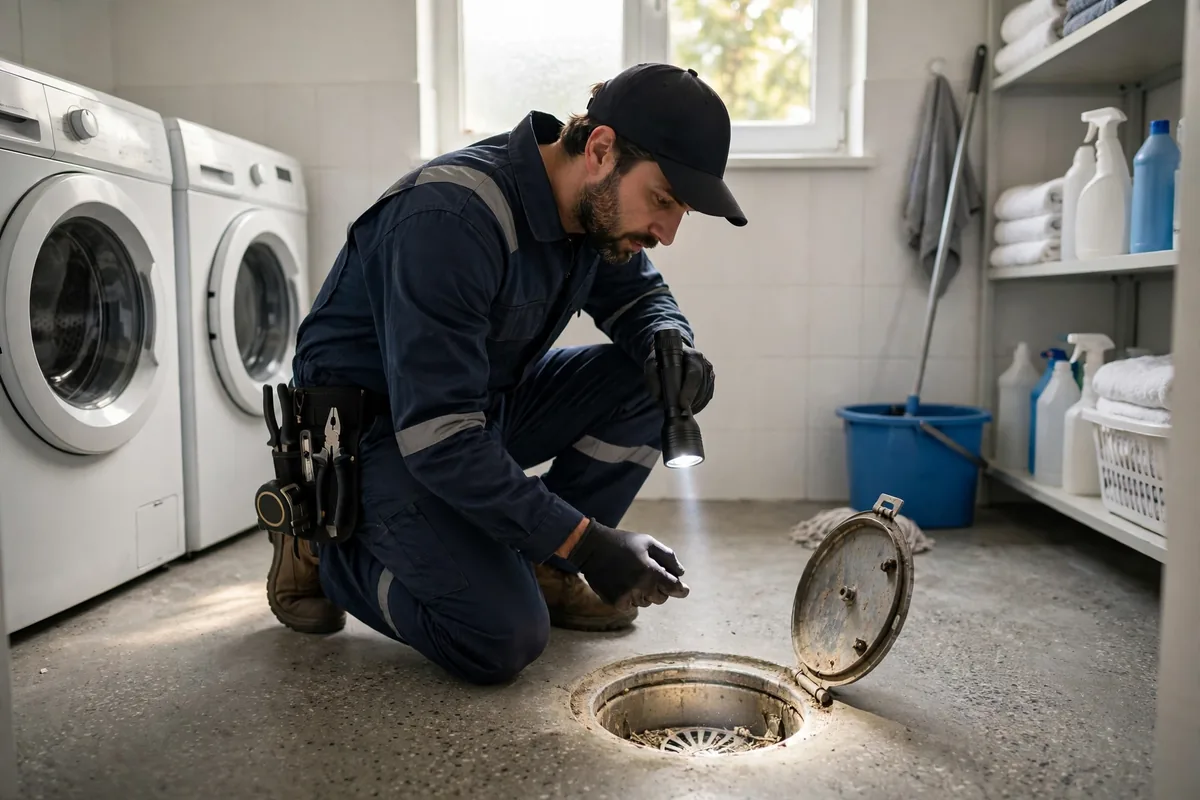
This guide works the list in the order a pro checks it, starting with the thirty-second test that solves the most common version: a cup of water into a floor drain that has not been used since spring.
The Pipes And Parts Behind It
Every drain system is three things: pipes, parts and a destination. The pipes are the sewer lateral outside and the main sewer line inside the property’s story; the parts are the cleanout, the P-trap under each fixture, the vent stack above, the floor drain below, and the grease trap on any commercial run.
Materials write the timeline. Cast iron pipe narrows with mineral scale and pipe corrosion; vitrified clay pipe stays round while its joints admit roots; PVC pipe is the low-maintenance youngster with a weakness for heat; Orangeburg pipe is the pensioner. A bellied pipe defeats them all equally. And the destination is either the municipal sewer and its storm drain sibling, or a septic tank in the yard.
The Tools A Pro Brings, And Why
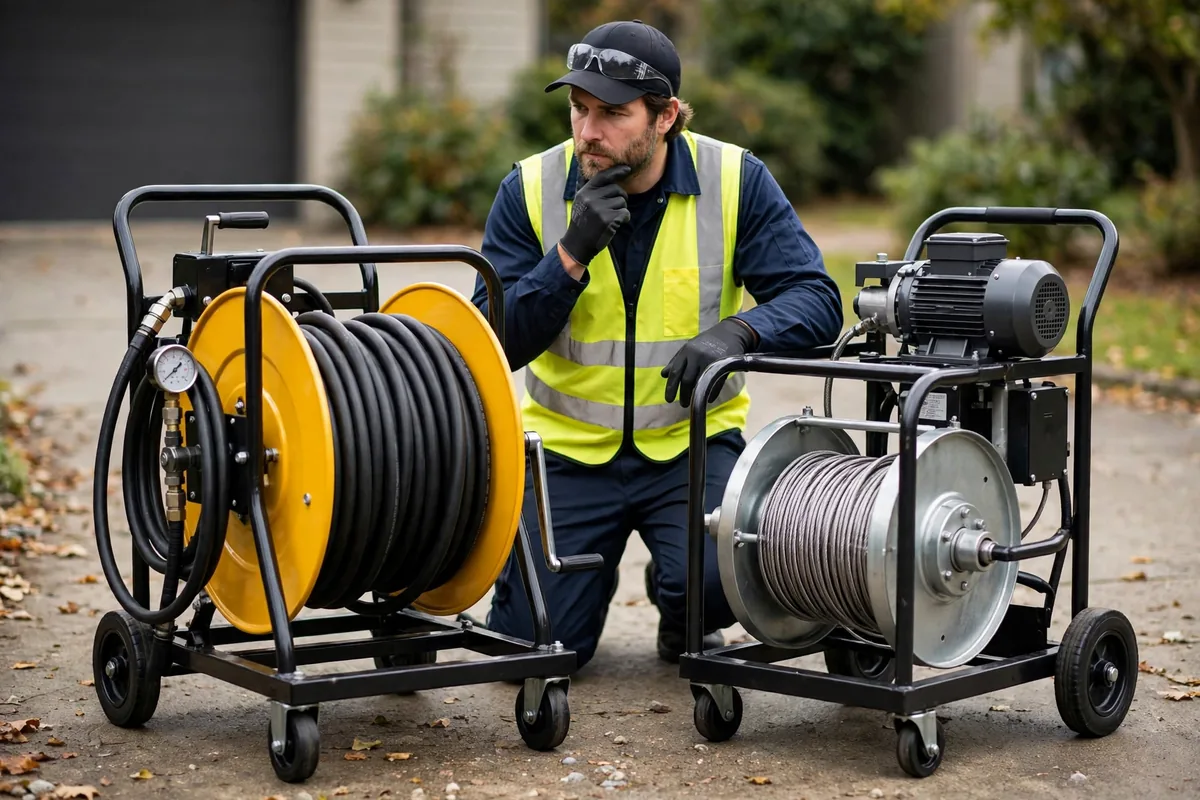
The truck carries a decision tree made of steel. The motorized drain snake (auger) cuts — roots, compacted waste, the simple stoppage. Fitted with a root cutter head it becomes a forestry tool. Hydro jetting scours: grease buildup (FOG), scale and sludge stripped off the wall at pressure.
The CCTV sewer camera referees: before, to choose; after, to prove. Chain descaling is the specialist for scaled iron, and sonde line locating lets the crew trace the camera head from the surface. Even the weather has entries in this kit: a frozen drain line and a sewer surcharge are cleared differently, and expansive clay soil explains why the line moved at all.
Reading The Signs Like A Pro
Odours are data too: a dry P-trap's smell is constant and local; a partial blockage smells after load; a vent stack problem smells in rhythm with drainage. Note what accompanies what, and you have done half the pro's diagnosis before they arrive.
Write the timeline down — drains reward historians. "Slow since spring, gurgles since the storm, backed up on Sunday" is a differential diagnosis in one sentence.
What DIY Can And Cannot Do Here
Homeowner territory is real but bounded: plungers for simple trap clogs, a hand auger for a bathroom branch, strainers and habits for prevention. That territory ends where the main line begins — deep blockages, charged lines and anything involving opening a cleanout under pressure are pro work.
The two DIY moves that cause professional-grade harm are chemical cleaners in a standing line and force — a rented snake driven hard into an old pipe. Both convert a cleaning into a repair. Knowing the boundary is not caution; it is the skill.
Older Pipes Deserve Older-Pipe Methods
The economics favour the filmed approach: one camera pass distinguishes the line that needs a $cleaning cycle from the line that needs a repair plan, and it dates the evidence. Old houses reward records the way they punish assumptions.
If you are buying an older home, put the sewer lateral on the inspection list beside the roof. It is the only major system that cannot be seen from a ladder — and the one whose surprise bill rivals the roof's.
Prevention That Actually Prevents
For the main line, prevention is a cycle set by evidence: root-prone clay gets its cut-and-jet interval from the footage, not from a mailer. Septic homes add tank pumping on the US EPA rhythm; municipal homes add nothing but attention.
And the cheapest prevention of all is response speed: a gurgle reported this week is a cleaning; the same gurgle reported after the backup is an emergency with a cleanup attached. Drains reward the attentive at wholesale prices.
When To Stop Reading And Call A Pro
Guides end; lines persist. If sewer smells in the house is happening in your house now, the shortest honest path is the one this site is built on: one free call, a local pro, a camera before a quote. Everything in this article was written so you can judge that visit when it happens — ask what the footage showed, and expect an answer. And if the problem arrived with a flood or a declared disaster, FEMA guidance and assistance may apply to the damage side — one more reason the paperwork starts with the pro's record.
Drain Problem Getting Worse?
One free call connects you with a local pro who can check it in person.
Call (800) 555-0100Free Call · Answered 24/7 · Local Pros Near You
Drain Cleaning Help In These Cities
Reading only goes so far — the line itself needs eyes on it. These city pages are where House Sewer Smell Causes becomes a visit: each carries its city's housing data, ZIP list and nearest served neighbours, plus the free number answered 24/7. Nearby state pages: Drain Cleaning Florida · Drain Cleaning Ohio.
House Sewer Smell Causes — Frequently Asked Questions
A real person answers 24/7 and can connect you with a local pro.
(800) 555-0100Reviewed By Hamza
Master Plumber & Emergency Drain Clearing Specialist
Hamza is a certified master plumber and emergency drainage specialist with more than 15 years of hands-on experience clearing main lines, sewer laterals and storm-drain systems. He has handled midnight sewage backups, root-choked clay laterals and grease-dam emergencies across hundreds of callouts, and he reviews every guide on this site for technical accuracy before it is published.
Updated October 31, 2026
Dealing With House Sewer Smell Causes Right Now?
One free call connects you with an independent local pro — answered 24/7, with arrival in 30–60 minutes in many cases.
Call (800) 555-0100Free Call · Answered 24/7 · Local Pros Near You